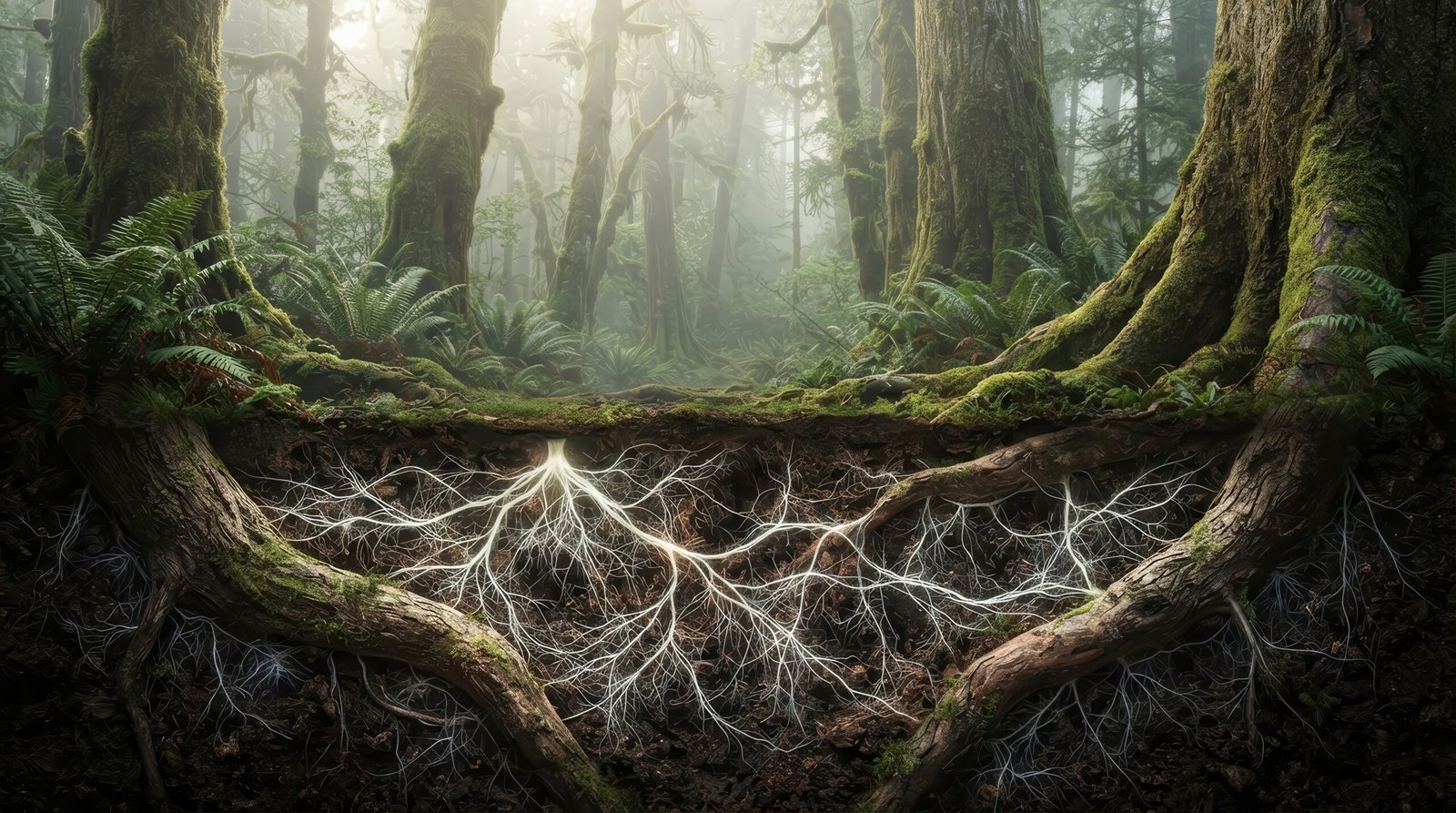
Trees have an underground network of communication that is crucial to their survival, yet many people don’t even know it exists. This is called the Wood Wide Web, or a mycorrhizal network, and it’s created through the mutualistic relationship between trees and mycorrhizal fungi. There are many types of mycorrhizal fungi, but the two most studied are arbuscular mycorrhizal fungi (AMF), the most common type, and ectomycorrhizal fungi (EMF). Together, mycorrhizal fungi form symbiotic relationships with over 90% of plants (Courty et al. 2010).
All types of mycorrhizal fungi are made out of hyphae: thin threads that attach to the roots of host plants, essentially acting as root extensions to help reach deeper into the soil for nutrients and water (Touseef 2023). Hyphae can connect to multiple host plants at the same time— although methods vary— creating a common mycorrhizal network between the plants. It’s more common for plants to be connected with AMF, whose hyphae make their way into the cortical cells of the plant’s roots. Through this process, they form small branching structures called arbuscules, which help transfer the nutrients between host plant and fungi. On the other hand, EMF will wrap itself around the root tips, growing around the roots instead of inside them (Touseef 2023).
The host plant makes carbohydrates through its photosynthesis, which the fungi absorb through the roots. In return, the fungi deliver nutrients from the soil to the plant. One of the most significant benefits that occur through this mutualism is the transfer of nutrients like nitrogen and phosphorus, which are essential for basic plant health. Notably, the transfer of phosphorus is one of the most important parts of the relationship, as trees need phosphorus to grow and store carbon (Kumari et al. 2025). The hyphal networks help reach deep, organic phosphorus in the soil that the tree’s roots alone could not have reached.
Additionally, because these networks can link multiple trees, they allow nurse trees to play a fundamental role in supporting other, needy trees. Nurse trees are adult trees who support seedlings by supplying them with water and nutrients using the hyphal networks (Courty et al. 2010). Since forests are dense, there is a lot of competition for seedlings that are stuck growing in the shade, so being connected to an adult tree helps them receive the nutrients they need. In one study, seedlings connected to a mycorrhizal network grew 60% more than ones that weren’t (Touseef 2023). This amazing phenomenon doesn’t end with just the transfer of nutrients and supplies, but trees also use these fungal networks to exchange signals. Trees warn against pathogens or potential herbivores by using the fungi network to tell other trees to trigger their chemicals or defensive genes that can help fend off the attack. This applies to plant-eating insects (Montesinos-Navarro et al. 2016).
Plants are among the most significant components of all ecosystems on earth. Besides the obvious role of providing habitat and food sources in forest ecosystems, trees help filter pollution, store carbon, and support immense biodiversity. It’s worth noting that in the United States alone, trees removed 17.4 million tons of air pollution during 2010 (Nowak et al. 2014). Trees also are a major driver of bird diversity and population all over the world, which is only one example of the many interconnected relationships that trees serve (Brockerhoff et al. 2017; Jakobson et al. 2017). Plants are the structure and building block of food chains as primary producers, which means their ability to survive and stay healthy is crucial. That’s why mycorrhizal fungal networks provide such a necessary role; trees heavily rely on their assistance to get more nutrients and water.
However, this underground network is more fragile than it looks, and any threats to these fungal networks can create serious and complex problems. As fungicide use increases on agricultural land to kill harmful fungi, chemical runoff is becoming a growing issue— and these fungicides are making their way into this vital mutualistic relationship. Next, I will dive into how these chemicals damage mycorrhizal fungi and what that could mean for the forests built on top of them.